Civilizational Equilibrium (CE)
A New Framework for Understanding Civilization, Power, and Balance
A lifetime of cross-cultural experience distilled into a unified theory of how civilizations rise, adapt, and survive.
Balance Triangle
Dynamic relationship of power, culture, trust
Feedback Loop
Detect → Respond → Adjust
Stress Compass
Internal vs external pressures
We are living in an age where imbalance spreads faster than correction. understanding equilibrium is essential.

About The Author
From a remote village in Northeast China to a life of global academic and professional engagement, Xingwu Liu’s work reflects a sustained effort to understand human society across cultures and systems.
Academic Background
Trained in cultural and medical anthropology, he studied at the Graduate School of the Chinese Academy of Social Sciences and Peking University. His academic work has included teaching, research, and international exchange, including experience as a Fulbright scholar in the United States.
Theory
A Structural Analysis of Civilizational Longevity and Resilience: Defining Balance Among Power, Culture, And Social Trust.
The theory suggests that civilizational longevity is determined by a dynamic equilibrium among five fundamental layers. It’s not a static condition but a continuous process, an ongoing negotiation between stability & change.
Abstract
Civilizational Equilibrium (CE) presents a theory of civilizational dynamics by focusing on how all its variables work together as a whole. It defines CE as the balance between five key layers, where symbolic, political, social, material, and adaptive layers remain balanced to sustain continuity across time. The book proposes that civilization’s survival depends not on achieving perfection, but it’s ability to continuously correct internal errors. By applying this theory, we can understand why some civilizations last long while others fragment and fail.
Core Premise
The main focus of Civilizational Equilibrium (CE) is that societal survival depends on the dynamic alignment of five propositions:
- Civilizations are dynamic systems.
- Imbalance produces instability.
- Feedback determines correction capacity.
- External pressure reshapes internal balance.
Our Book
Introducing a groundbreaking framework that explains why civilizations rise, adapt, or fall by examining the dynamic alignment of five critical layers. Moving beyond the causes like geography, wealth, or population, the book argues that civilizational survival depends on a robust capacity for continuous self-correction and adaptation. Master the knowledge of civilizational longevity. Explore your copy!
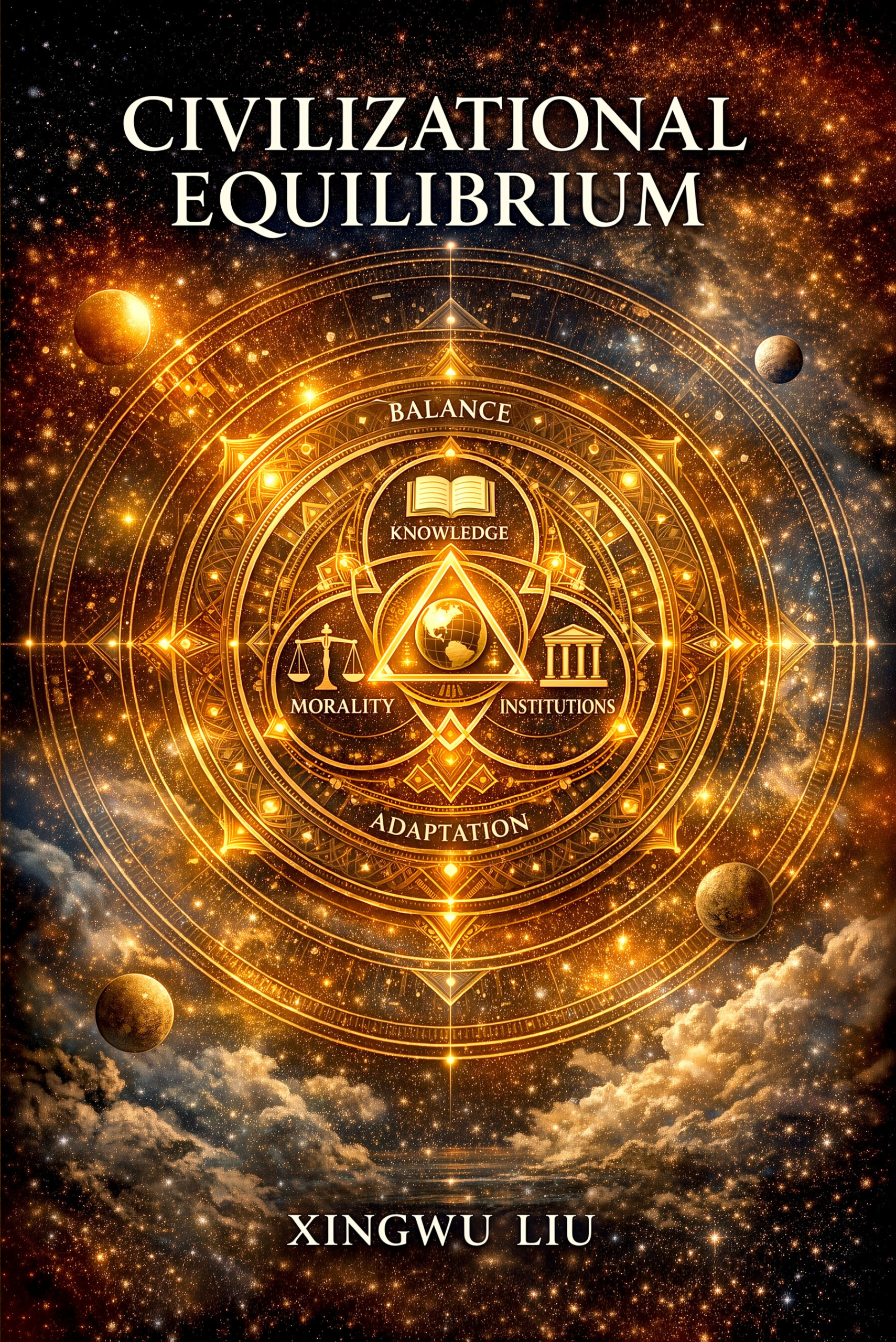
Ebook / $15.00
Civilizational Equilibrium
A convenient digital edition for instant access to the foundational theory of civilizational longevity and the essential role of feedback loops in preventing systemic collapse.
Paperback / $27.99
Civilizational Equilibrium
A portable, high-quality print edition featuring an in-depth analysis of structural resilience and how civilizations reconstruct coherence after periods of crisis.
Hardcover / $55.99
Civilizational Equilibrium
A portable, high-quality print edition featuring an in-depth analysis of structural resilience and how civilizations reconstruct coherence after periods of crisis.
Book Trailer
Ideas
Explore a collection of analytical insights and short essays that apply the structural framework of Civilizational Equilibrium to the most pressing challenges of our time. By examining the complex relationship between information flow, institutional power, and adaptive capacity, these writings illustrate how the principles of structural alignment determine the fate of modern human orders.
Trust as the Core Infrastructure
of Civilization
Civilizations do not collapse from lack of resources,
but from the erosion of trust that holds systems together.
Power
The invisible forces that shape collective behavior.
Designing Governance
Principles for institutions that can learn and evolve.
Systems Thinking
Seeing the whole to act with clarity.
The Anatomy
Patterns, breakdowns, and early signals.
Balance as
From equilibrium as a state to balance as a habit.
Feedback Loops
How feedback shapes our collective trajectory.